Hospitals and clinics that are not functioning with purpose-built healthcare applications lose their patients to their competitors who provide digital convenience. Missed appointments, poor, fragmented records, and disconnected care workflows cost healthcare organizations revenue, reputation, and clinical outcomes. Without a consistent healthcare mobile application, patient engagement decreases, administrative costs increase, and regulatory exposure increases. The disconnect between what is done analogously and what a patient expects increases every quarter.
Our healthcare app development services provide end-to-end healthcare solutions – from clinical app development and telemedicine platforms to patient portals and remote monitoring systems. Every app is architected to be HIPAA compliant, ABDM ready, and EHR integrated. The development methodology focuses on security-first design, intuitive clinical workflows, and quantifiable patient results. Whether you’re looking for a healthcare mobile app for a single specialty clinic or a multi-facility hospital chain, every solution ships production-ready and regulation-compliant.
With extensive hospital, diagnostic center, and digital health startup experience, this team understands the intersection of clinical workflows and software engineering. Unlike generic app development companies, all healthcare app developers that are working on the project have domain expertise in medical informatics, compliance frameworks, and patient-facing design patterns. The result is healthcare application development that performs under clinical scrutiny, rather than QA testing.

Every healthcare mobile app development project begins with clinical workflow mapping – and not wireframes. The team studies patient journeys and pain points for providers and administrative bottlenecks, before writing a single line of code. This ensures the final product reduces friction in the real care environment, and not just demo screens.

Regulatory compliance is built into the architecture from sprint zero. HIPAA, ABDM, India IT Act, and GDPR requirements are met using encryption protocols, access controls, audit logging, and consent management systems. No bolt-on compliance. No last-minute security patches. Certified and audit-ready, from day one.

Deep integration capabilities with India’s digital health ecosystem – including ABHA ID, UPI-based payments, DigiLocker, and Ayushman Bharat Digital Mission APIs. This gives healthcare organizations a compliance and interoperability advantage that is just not available with offshore-only medical app development companies.

Healthcare app development is a wasted investment if it is not measurable. Every project comes with embedded analytics – appointment conversion rates, patient retention analytics, feature adoption analytics, and clinical workflow efficiency benchmarks. Quarterly performance reviews ensure improvement of the app, rather than mere operation.

Healthcare apps to be built here in turn connect to existing hospital infrastructure using HL7 FHIR, SMART on FHIR, and custom API protocols. EHR/EMR integration, lab system connection, pharmacy data exchange, and insurance verification are standard deliverables – not expensive add-ons requiring separate contracts.

App launching is milestone one and not the finish line. Post-deployment support includes real-time monitoring, performance optimization, keeping the compliance up to date with regulatory changes, feature iterations based on the data gathered from user behavior, and dedicated incident response. Long-term partnerships ensure that healthcare mobile applications remain up to date and clinically relevant.
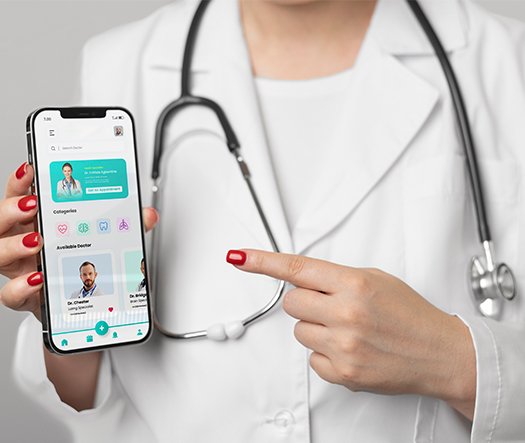
Healthcare app development is important because the trust of patients, the efficiency of the medical staff, and the growth of the organization depend upon the technology that functions under pressure. A well-engineered healthcare mobile application positively impacts no-shows by intelligent scheduling, diagnoses by integrated lab reporting, and retention of patients by seamless patient communication. This is not surface-level benefits.
They compound into operational savings, better clinical results, and stronger competitive positioning. The team behind every custom healthcare app development project brings cross-disciplinary expertise – clinical informatics, security engineering, UX research, and healthcare compliance to ensure your app delivers measurable value from the first sprint.
Partner with healthcare app developers who have a grasp of clinical reality.
Every healthcare mobile app development engagement utilizes a proven, compliance-first methodology aimed at minimizing risk and speeding time-to-value.

Clinical stakeholders, administrators, and end users are interviewed to map out existing workflows, pain points, and outcome goals. Regulatory requirements – HIPAA, ABDM, and region-specific are documented. Competitive analysis identifies feature gaps. The phase ends with a validated project scope, compliance matrix, and feasibility of technical options that guide all subsequent decisions.

System architecture is designed to be secure, scalable, and interoperable. Database schemas, API structures, authentication protocols, and encryption models are defined. Integration points with EHR/EMR systems, payment gateways, and third-party services are mapped. Infrastructure in the cloud (AWS/Azure) is provisioned. This phase delivers a detailed technical blueprint and a compliance-validated architecture document.

UI/UX design is based on healthcare usability research – accessibility standards, clinical context awareness, and patient demographics. Wireframes have clinician and patient testing cycles, and then visual design can begin. Responsive layouts are optimized for exam rooms, waiting areas, and home use. The deliverable is a clickable prototype validated by actual healthcare users.

Front-end and back-end development continue in 2-week agile sprints. HIPAA-compliant data handling, role-based access controls, and encrypted communications are built into each module. Continuous integration and automated testing allow catching issues early. Sprint reviews involve clinical stakeholder sign-off. The product of this is a functioning MVP with core functionality, operational and security controls turned on.

Comprehensive testing in security penetration, load performance, regulatory compliance, clinical accuracy, and user acceptance. HIPAA audit simulations are a way of making sure that data protection protocols are in place. Cross-device and cross-browser testing ensures consistent performance. A third-party security assessment validates vulnerability management. The phase concludes with a compliance certification package and a build ready for deployment.

Production deployment is done in a staged manner – pilot clinic first, then phased expansion. Data migration from legacy systems is carried out using zero-downtime protocols. Staff training programs lead to adoption readiness. Post-launch monitoring is used to track performance, uptime, and user behavior. Ongoing maintenance contracts include security patches, feature updates, and adjustments to comply with changes to the regulations.
Having experience in 1,000+ client engagements and multiple healthcare verticals, the results speak for themselves with measurable improvements. Explore real-world results.
App development for healthcare requires more than technical skill – it requires an understanding of the way different medical environments work. From small practices of a single physician to 500-bed hospital systems, the method is scalable without compromising clinical precision. Every solution focuses on sustainability, the portability of data, and long-term scalability. Startups get the same compliance rigour as the enterprise clients. The commitment is the same: build healthcare apps, addressing real operational issues.
Healthcare cross-industry experience sharpens every engagement. Working across multi-specialty hospitals, dental chains, ophthalmology clinics, diagnostic laboratories, pharmaceutical companies, mental health platforms, fertility clinics, and wellness centers leads to pattern recognition, which accelerates development. Solutions successfully proven in one healthcare vertical inform better architecture decisions in the next. This leads to an accumulation of insight to reduce project risks and improve patient-facing results.

Healthcare application development services here are honed through hundreds of clinical deployments, rigorous post-launch analysis, and continuous feedback from healthcare providers who use these apps daily. The recognition given by healthcare organizations throughout India reflects a commitment to quality beyond code delivery.
Regulatory Intelligence Built In: Compliance frameworks for HIPAA, ABDM, DISHA, and the India IT Act are built in at the lifecycle of development – not added retroactively.
Clinician-Validated User Experience: Before deployment approval, every interface is tested with doctors, nurses, and administrative staff in real clinical settings.
Outcome-Linked Development Contracts: Project milestones are linked to measurable healthcare outcomes – patient adoption rates, gains in workflow efficiency, and uptime benchmarks for systems.
Every medical app development project is based on proven, enterprise-grade technologies that have been chosen for security, performance, and long-term maintainability. Here is the technical basis for our healthcare solutions.









Vishal’s team transformed our lease application from a conversion killer into a revenue driver. The 42 percent improvement in conversion rate directly impacted our bottom line, and reducing completion time from eighteen to six minutes made the process actually enjoyable for customers.
TIS took our 2010-era warehouse management portal and completely transformed it into a modern, intuitive platform through deep user research and human-centered design. Customer satisfaction jumped from 42 to 87 percent, and our clients now view the portal as a competitive advantage rather than a necessary evil. The role-based dashboards and mobile responsiveness they designed have fundamentally changed how our customers interact with their inventory data.
TIS transformed our dashboard from a data dump into a decision-making tool. Executives can now identify critical trends in thirty seconds instead of spending hours compiling spreadsheets.
Considering a healthcare app development company? Here are some answers to the most important questions.
Evaluate four critical factors. First, check for healthcare domain knowledge – the company should have some examples of projects completed in telemedicine, EHR integration, or even patient engagement, and not just mobile development in general. Second, verify experience with compliance for HIPAA, ABDM, or GDPR, depending on your market. Third, ask for references from healthcare clients who can speak to the quality of the post-launch support. Fourth, check their discovery process – a good healthcare app development company will want to spend time understanding your clinical workflows before suggesting solutions. Avoid companies that rush to feature lists without having a relevant understanding of your care delivery model.
The dependency of timelines is on scope and complexity. A focused MVP with core features – patient registration, appointment booking, secure messaging – typically takes 10-14 weeks. A mid-complexity healthcare mobile app with telemedicine, payment integration, and basic EHR connectivity takes 16-24 weeks. Enterprise platforms with multi-role access, advanced analytics, wearable integration, and full EHR interoperability take between 24 and 40 weeks. These estimates encompass discovery, design, development, testing, and validation for compliance. Rushing compliance-sensitive healthcare mobile app development leads to technical debt that is more expensive to correct later.
Healthcare apps in India must comply with the Information Technology Act 2000, the Digital Personal Data Protection Act 2023, and the Telemedicine Practice Guidelines 2020 issued by the Board of Governors (Medical Council of India). Apps that are international patient handling apps should also comply with HIPAA (US) or GDPR (EU). Integration with the Ayushman Bharat Digital Mission of India requires following the ABDM sandbox protocol and ABHA ID Verification standards. A good healthcare application development company will incorporate these requirements in the architecture from the beginning.
A structured healthcare app development process will generally have six phases: discovery and requirements gathering, system architecture design, UI/UX design with clinical validation, agile engineering with sprint-based development, thorough quality assurance and compliance testing, and staged deployment with post-launch monitoring. Each phase delivers specific deliverables – scope documents, architecture blueprints, validated prototypes, tested builds, and compliance certificates. The best medical app development services keep the stakeholders involved throughout the process to ensure that the final product is true to clinical reality.
Essential features for a healthcare mobile application are secure user authentication with multi-factor authentication, appointment scheduling with real-time availability, in-app telemedicine video consultation capability, access to electronic health records, prescription and medication management, lab reports delivery, secure in-app messaging, payment processing with UPI and insurance integration, and appointment reminder push notifications. Advanced features such as AI-enabled symptom evaluation, integration with wearable devices, clinical decision support, multilingual interface, and analytics dashboard for administrators. Feature selection should be guided by your particular clinical workflows and patient demographics.
Data security in healthcare app development works at various levels. End-to-end encryption ensures data in motion and data at rest. Role-based access controls limit the visibility of information by type of user – patient, doctor, administrator. Multi-factor authentication works to prevent unauthorized access. Audit logging is used to track all the data access events for compliance reporting. Penetration testing, which is done regularly, is used to identify vulnerabilities. Secure API gateways to secure the exchange of data with external systems. HIPAA-compliant cloud infrastructure (AWS or Azure) forms the basis of hosting. A responsible healthcare app development company gets third-party security audits done before any major release.
Yes. Healthcare App development incorporating integration with existing hospital infrastructure – EHR/EMR systems (Epic, Cerner, custom platforms), lab information systems, radiology systems (PACS), pharmacy management software, billing and revenue cycle management software, insurance verification databases. Integration is facilitated via HL7 FHIR APIs, custom middleware, and secure data exchange protocols. The technical team has experience working with both international healthcare IT standards and India-specific hospital management systems. Integration complexity is determined in the discovery phase in order to avoid scope surprises.
Three distinct factors separate this team from other healthcare app development companies. First, every project starts with clinical workflow analysis – not a generic requirements checklist. This means the app fits the way healthcare is delivered, not the way it theoretically works. Second, compliance is designed into architecture, not applied at the end. Third, post-launch engagement involves analytics of performance, compliance, and feature iterations based on real user behavior data. Most medical app development companies vanish once deployed. This team remains invested in outcomes that can be measured.
Post-launch support is a standard part of the engagement, not something that is added on. Support coverage includes 24/7 uptime monitoring, incident response, security patch deployment, OS and device compatibility updates, regulatory compliance adjustments, performance optimization, and feature enhancements based on usage analytics. Maintenance contracts are arranged as long-term partnerships with specified SLAs, monthly performance reports, and quarterly review cycles. Healthcare mobile app development is an ongoing process – clinical requirements change, regulations change, and expectations change. The support model is intended to ensure your app stays up to date and clinically relevant.
The healthcare app development portfolio offers the complete range of medical and health technology solutions. Some of these technologies include telemedicine and virtual consultation platforms, patient engagement portals, remote patient monitoring applications, electronic health record systems, hospital and clinic management apps, pharmacy and prescription management tools, mental health and therapy platforms, fitness and wellness applications, diagnostic lab management systems, clinical trial management apps, insurance and claims processing platforms, and emergency response applications. Each type of app is developed with its own regulatory, security, and usability requirements taken care of from the design phase.
User experience in healthcare mobile app development is more than just good aesthetics. The process of UX involves field research with real patients/clinicians, accessibility testing for the elderly and differently-abled, interface optimization according to workflow (exam room vs. waiting room vs. home), and iterative usability testing with real healthcare scenarios. Typography, color contrast, touch targets, and information density are tuned to clinical settings. Doctors require speed and density of data. Patients need simplicity and reassurance. The design system does not compromise on either.
Yes. Healthcare mobile application development for the Indian market includes support for a multilingual interface. Apps can be set up for Hindi, English, Tamil, Telugu, Bengali, Marathi, Gujarati, Kannada, and other regional languages, depending upon your patient demographics. Language switching is smooth and persistent between sessions. Medical terminology localization is done according to set healthcare translation standards to ensure clinical accuracy. Multilingual capability is particularly important for patient-facing functionality – features like appointment booking, medication instructions, for example, as well as discharge summaries and health education content.
Healthcare app development for startups is based on an MVP-first approach. The discovery phase determines what minimum set of features is required to test the minimum set of features necessary to prove the core value proposition among real users. Development based on the top three to five features that directly affect the engagement of patients or clinical workflow efficiency. The MVP ships within 10-14 weeks with complete coverage of compliance. Post-launch analytics: Post-launch analytics help to make decisions about feature expansion. This approach means making a 40-60% reduction in initial investment while not compromising security or standards for regulations. Scaling occurs on the basis of validated user demand, and not assumptions.

C – 81C, Sector – 8, Noida 201301, India


1025 Beamon Drive, Franklin 37064 Tennessee, USA
Sveavagen 34 111 34 Stockholm, Sweden

Copyright ©MDA. All rights reserved.