Problem & Business Impact: Hospitals are being chosen online. They research doctor’s credentials, reviews, services and book appointments – all on their mobile phones. If it’s ugly, cumbersome or slow, they go somewhere else. Without a medical website, 60% of patient requests are lost for hospitals and clinics. Ugly medical websites are not just ugly. They’re costly, distrusted and bury your medical brand in a world where the only expectation is the best online experience for patients.
Solution & Delivery: The solution is healthcare web design. We build websites that convert patients – from searches to appointments. Our team of healthcare website designers incorporates clinical healthcare research, India-regulatory compliance, and performance engineering to build websites that perform well in search rankings, load fast and convert patients. So whether you’re looking for a single-doctor portfolio website or a 200-page multi-specialty hospital site, the design and development will be built around the patient, mobile-first, and with SEO baked in.
Credibility & Differentiation: The past 10 years of our work has solely been dedicated to serving the digital requirements of hospitals, labs, single speciality clinics, pharma and wellness startups in India. We are familiar with the National Medical Council code of ethics on medical advertising, the ABMD guidelines for digital health, and other limitations on medical advertising. This is the core difference between a medical web agency and a web studio. Your website deserves that distinction.

Wireframes are based on patient behavior studies, not trends. Menus are based on care-seeking search for symptoms, specialties, doctors and action for appointments. This leads to less bounce and form abandonment. This means patient-friendly websites that are user-friendly for all ages and tech-savvy levels.

Compliance built in Design adheres to country-specific medical guidelines and regulations, such as NMC code of advertising and DPDPA data protection and privacy, across all website pages, forms and patient interactions. You shouldn’t trust your medical web design company with your license. We never will.

Look nice, but look nice enough to click. Each page is engineered for optimal placement of call-to-action, trust symbols at key points and efficient appointment processes. Our medical web design goes click to visit. Our approach has led to 30-50% more online appointment requests for hospitals.

The web design for a single-specialty clinic is different to that of a 500-bed hospital. Our medical website design includes scalability – template pages, dynamic doctor profiles, department microsites. Your site never needs to be rebuilt. Your site grows as your business grows.

Digital patterns and language differs between the tier-1, tier-2 and tier-3 cities. Our health care website design studio uses geo-locating content and language, multi-lingual user interface and landing pages. We have websites from Delhi NCR to the new entrants in health care, where the digital assets are targeted to the end user.

We consider the website launch as the beginning. Analytics, CRO, security and regular refreshes are all part of the process. We have been working with hospital web design companies for many years. Continual improvement is standard practice.
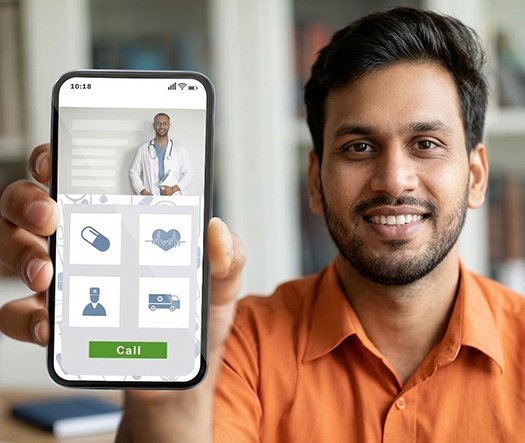
A medical website is not a brochure. It’s your number one patient generator. When done right, medical website design affirms your medical authority even before your patients arrive for an appointment. It answers their questions, eases their worries, showcases your expertise and makes appointments easy. The benefits are more than skin deep. An effective medical website reduces the strain on your front desk, makes it easier for patients to prepare for their appointment, helps referring doctors and boosts your brand in search engines and answer engines based on artificial intelligence. Our team of medical UX experts, tech developers familiar with compliance issues and medical content strategists understand that every aspect of user design either builds or undermines patient trust.
Partner with a specialized team that understands healthcare inside out.
We strive for low-risk, predictable clinical and business outcomes in our healthcare web development.

We conduct a review of your current website, patient and market, and key clinical services. We speak with hospital executives, chief of departments and front desk administrators to get to the heart of patient issues. We offer a requirements brief, sitemap and compliance brief. We never wireframe before discovery.

We create information architecture by patient intent, not org chart. Web page hierarchy, URL and navigation is designed for patient search, comparison and decision-making. Structured data, local SEO keywords, and AEO content structure is established. We deliver signed-off sitemap, wireframes and specs.

Design follows architecture. We mock up responsive desktop, tablet and mobile designs with your branding, medical images and other trust signals. We benchmark your designs against conversion best practices – Call to Action (CTA) prominence, form length, trust elements and scroll depth. You approve the designs.

We review simultaneous sprints of front and back-end development each week. Content management system (CMS) integration, doctor availability, appointment booking, doctor directory and patient portal integration is built on secure and scalable platforms. Our goal is page load times of less than 3 seconds, Core Web Vitals adherence and browser compatibility. You get access to staging environments for testing.

On-page and image optimization, accessibility (WCAG 2.1 AA), security is checked. NMC, accuracy and keywords are checked for content. Load testing is performed. Conversion, heatmap and tracking services are in place.

Post-launch support begins immediately with 30-day performance benchmarking, conversion funnel analysis, and patient feedback integration. Ongoing reporting includes growth in organic search traffic, appointments booked, time on pages and technical website performance. New content and new features are introduced along with A/B testing. This is the Holy Grail of hospital website design – product to growth machine.
We've delivered over 1,000 medical websites to multi-specialty hospitals, laboratories, individual practices and pharmaceutical companies. Here's how medical website designers can increase your patient base, and look good too.
Medically-focused web design is a focus for our team, and is driven by three principles: clinical accuracy, scalability and patient engagement. Design principles focus on access, trust and conversion regardless of the size of the medical institution, be it a 10-bed nursing home or a 1,000-bed teaching hospital. New telemedicine startups and multi-city diagnostic chains both benefit from scalable architecture that doesn’t need to be torn down.
Our broad healthcare experience informs each project. Cardiology taught us the importance of urgency in UX. Designing for cancer hospitals taught us the importance of compassionate content architecture. IVF clinics needed delicate design. Drug company websites needed regulatory rigour at scale. This collection of dentists, eye hospitals, mental health clinics, orthopaedic hospitals, Ayurveda and wellness brands, pet clinics, pathology laboratories, medical device manufacturers – is a healthcare web design company with a specialty.

Precision separates competent healthcare web design services from exceptional ones. Every pixel, every piece of text, every form field is assessed by one question: does this component add to patient confidence and prompt an action? That’s why we are asked time and again by the best hospitals, diagnostic chains and health startups in India for our expertise in clinical precision and conversion science.
Healthcare-Only Design Focus
No e-commerce, no retail, no restaurants. We are exclusively engaged in designing and building for the healthcare sector, and are the undisputed experts in medical website design.
Regulatory Compliance Embedded
Projects are NMC, DPDPA compliant and integrated with the ABDM – meaning your medical practice won’t fall foul of the regulatory pitfalls others might face.
AI and AEO-Ready Architecture
Websites are Google and AI friendly, meaning your hospital will appear in Google and AI searches.
Our hospital websites are built with the best-of-breed platforms, frameworks and performance technologies. Our technologies are chosen for security, scalability, performance and maintainability for small and large hospital websites.









Vishal’s team transformed our lease application from a conversion killer into a revenue driver. The 42 percent improvement in conversion rate directly impacted our bottom line, and reducing completion time from eighteen to six minutes made the process actually enjoyable for customers.
TIS took our 2010-era warehouse management portal and completely transformed it into a modern, intuitive platform through deep user research and human-centered design. Customer satisfaction jumped from 42 to 87 percent, and our clients now view the portal as a competitive advantage rather than a necessary evil. The role-based dashboards and mobile responsiveness they designed have fundamentally changed how our customers interact with their inventory data.
TIS transformed our dashboard from a data dump into a decision-making tool. Executives can now identify critical trends in thirty seconds instead of spending hours compiling spreadsheets.
Sub-heading: Want to redesign your healthcare website? Here are some of the questions we get from hospital administrators and clinic owners.
Check if they are experienced. A web designer isn’t a medical web designer. Ask to see some hospital, clinic or pathology web sites. Ask about their expertise with medical compliance: NMC advertising standards, data privacy and accessibility standards. Ask about ongoing maintenance, Search Engine Optimisation and conversion analytics. Ask about clinical UX, not just design. They are healthcare savvy, not web savvy.
4-6 weeks for a clinic website. A complex hospital web design project with custom built features, doctor listing, patient login portals and multi-departmental website structure can take 8-16 weeks. This is subject to availability of content and feedback from stakeholders and integration. Telemedicine integration, ABDM integration or EHR integration projects take longer. Project plans with deliverables at each milestone creates transparency and accountability for both parties for medical web design projects.
Essential include online booking, doctor profiles and search by speciality and/or department and service pages, patient reviews and testimonials, secure contact form and responsive design. Advanced features include patient portals, telehealth links, health blogs, insurance verification, multilingual, chatbots for website navigation. Features should encourage actions from patients – book, call, download, enquire. Less is more. Medical websites should be designed with simplicity and user-friendliness to keep patients on track.
Medical websites have different regulations than commercial websites. Web content must adhere to NMC advertising standards. Data gathering must be encrypted and secure according to DPDPA. Websites must adhere to accessibility standards (WCAG 2.1) for the elderly and differently-abled. Health care content needs to be accurate but not make unsubstantiated claims. Health care websites also require specific UX design patterns – symptom-driven menu, visibility of emergency contacts and display of credentials. A web designer without medical training cannot cover these bases.
Yes. We design medical websites for single providers, single-specialty clinics, multi-specialty clinics, multi-location hospital chains and diagnostic labs. We estimate and quote for each project individually. A dermatology practice is different than a 300-bed, multi-specialty hospital. We don’t have a “template” approach. We create websites designed specifically for your target audience, services, location and business goals.
Absolutely. SEO is integral, beginning in discovery. Your website project includes URL structure, heading hierarchy, schema markup, local search engine optimization, image optimization and Core Web Vitals optimization. Projects by a healthcare web design company also include AEO (AI search engine optimization) so that your website content can be used to power AI search. Once the website is live, ongoing SEO and content updates keep your website in competition with Google and other search engines for your target specialities and locations.
Yes. We adopt a migration-safe approach to redesigns that preserves your search engine rankings. This involves 301 redirects for all URLs, metadata migration, audit and maintenance of backlinks, and tracking via Google Search Console during the migration. We retain and enhance current successful content. We retain search traffic during the migration and increase it after launch due to improved site architecture, performance and content.
Indian healthcare websites comply with NMC guidelines barring promotional statements, testimonials and discounts for medical services. Using forms on websites is governed by the Digital Personal Data Protection Act (DPDPA). The website is accessible to the differently abled as per accessibility guidelines. Hospitals have to be compatible with ABDM as part of the National Digital Health Mission. An Indian medical website design company, in the design phase, we ensure compliance with the website structure, content and form designs.
It all begins with the patient’s journey. We put appointment CTAs at places of intent, show doctor credentials near appointment forms, use click to call buttons for mobile site and shorten form fields. We display trust elements – accreditations, patient numbers, doctor credentials – at appropriate places. After the website is launched, we A/B test headlines, CTAs and appointment forms. We generate reports for appointments, calls and form submissions every month.
Yes. Our medical writers are proficient in creating medically accurate, SEO-friendly and patient-friendly content. We create doctor’s bios, department pages, treatment/procedures pages, health blog posts, and FAQs. Content is reviewed against NMC advertising guidelines to prevent compliance violations. The content is written in plain English, not medicalese. Translation services for Hindi, Tamil, Telugu, Bengali and other languages are also available for hospitals to reach patients in their in their native languages.

C – 81C, Sector – 8, Noida 201301, India


1025 Beamon Drive, Franklin 37064 Tennessee, USA
Sveavagen 34 111 34 Stockholm, Sweden

Copyright ©MDA. All rights reserved.