
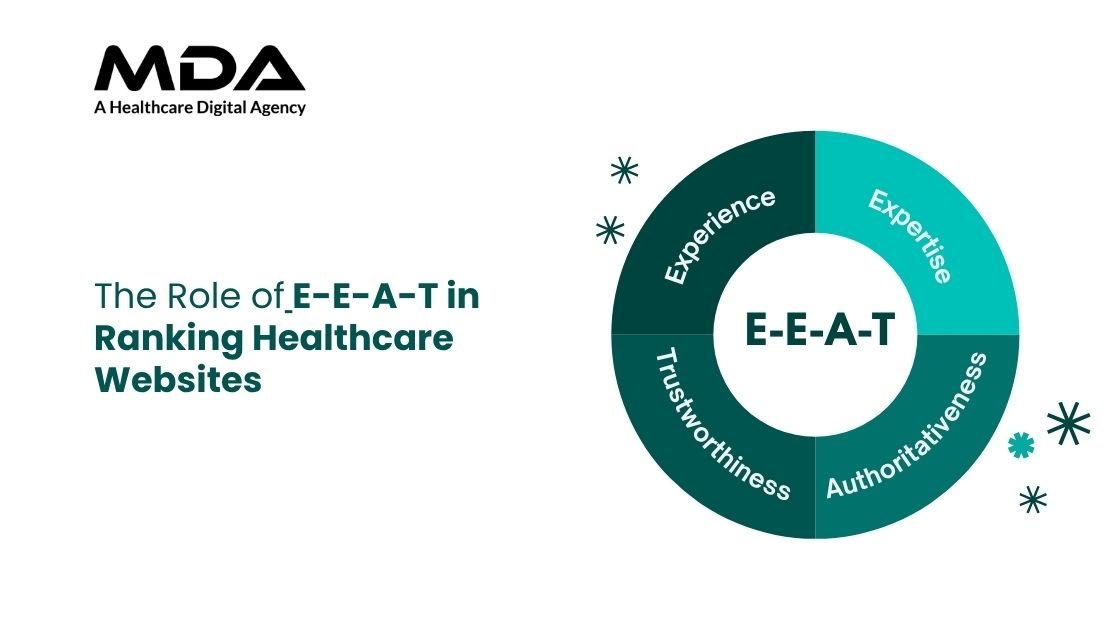
Google doesn’t treat all websites alike. For healthcare organizations competing in search results, understanding why your hospital, clinic, or medical practice is on page one, or doesn’t require understanding E-E-A-T: Experience, Expertise, Authoritativeness, and Trustworthiness.
This framework is used to determine how search engines assess the quality of medical content. For healthcare providers, it has a direct effect on the discovery of patients, volume of appointments, and competitive positioning. Organizations that match their digital presence with E-E-A-T principles outperform competitors consistently in organic visibility, regardless of marketing budget.
This guide explains how E-E-A-T works for healthcare search, why it is more relevant to medical organizations than other industries, and what specific changes can be made to improve rankings and patient trust at the same time.
Google classifies healthcare websites as YMYL- Your Money or Your Life. Content in this category can have a direct impact on the reader’s health, safety, or financial security. Search algorithms subject YMYL sites to a more stringent quality evaluation because the impact of inaccurate medical information is real-life damage.
Healthcare Websites are under more scrutiny than e-commerce, entertainment, or general business websites. A poorly obtained symptom guide or false treatment claim can result in patient decisions with grave consequences. Google’s quality raters specifically evaluate medical content based on accuracy, credentials of authors, and clinical reliability.
Organizations who are ignoring these signals experience a decrease in rankings despite having good technical SEO. Competitors who have the weakest backlink profile, but have the strongest trust factors, tend to rank well for high-intent medical queries.
Experience means first-hand involvement with the subject under consideration. For healthcare providers, this means not marketing teams or freelance writers with no medical backgrounds, but content written or reviewed by practicing clinicians.
Google’s algorithm is looking for signals that content is coming from an actual medical practice. Author bios matter. A cardiologist who writes about heart disease treatment has more weight than a general health blogger who covers heart disease.
Practical application: Every clinical article should have author credentials displayed prominently. Include medical degrees, board certifications, current practice affiliations, and pertinent specializations. Link author names to dedicated bio pages with information on clinical experience and history of patient care.
Expertise is a measure of whether the content creator has recognized knowledge in his/her field. For healthcare organizations, this includes:
Board certifications that are prominently displayed on provider pages
Search algorithms cross-reference the names of authors with medical databases, published literature, and professional directories.
A surgeon with peer-reviewed publications on a given procedure has measurably better signals of expertise than one with no such publications.
Do not have generic team pages with names without context. An individual practitioner profile depth showcasing specific expertise areas is needed for each practitioner.
Authoritativeness is how your organization is viewed by the medical community as a whole and by patients. This is not limited to individual provider credentials but goes on to institutional reputation.
Signals Google looks at include:
A hospital that is recognized by JCI (Joint Commission International) or NABH (National Accreditation Board for Hospitals) has more authority than one that is unaccredited. Similarly, a clinic that is part of the region’s health news coverage gives evidence of community standing.
Many healthcare providers have a digital marketing agency for chiropractors or a specialized healthcare marketing agency that helps them systematically begin to build these authority signals through PR, digital outreach, and strategic medical associations.
Trust is the most important E-E-A-T component for healthcare. Patients need to be assured that your information is correct, that your credentials are valid, and that your organisation is putting their wellbeing first.
Trust signals that Google monitors include:
Healthcare organizations that make unrealistic promises – “cure diabetes naturally” or “guaranteed surgical outcomes” – incur trust penalties. Content needs to reflect the clinical reality, including the limitations and possible risks of treatment.
Search algorithms use E-E-A-T as a ranking factor, but not in what used to be the way keyword density used to work. Google’s quality raters manually score healthcare websites for E-E-A-T guidelines, and their evaluations are used to train machine learning models that score rankings at scale. When your hospital’s cardiology content is competing against other local providers, Google compares:
The site with more E-E-A-T criteria held in Google dumps the competition with better traditional SEO metrics. This is one reason why recently-launched healthcare websites with strong credibility signals can overtake established healthcare websites with weaker medical authority signals. It also explains why content mills creating generic health articles keep losing visibility.
For organizations that invest in Google search ads for doctors, the organic E-E-A-T optimization complements the visibility paid to do. And patients clicking on ads but finding websites with low trust don’t convert. Strong E-E-A-T has both paid and organic performance boost as it will increase the credibility of the landing page.
Audit existing content Authorship
Review all clinical articles, procedures, and all health resources. Identify content that does not have clear medical authorship. Assign qualified physicians to review and approve this content and add their credentials.
Remove or update anything that makes unverifiable medical claims. Replace ambiguous statements with clinically accurate, clinically sourced explanations.
Optimize Provider Profiles
Expand individual physician pages with extensive credentials, specialties, education, and experience. Include professional headshots and personal statements on their approach to patient care.
Link to external verification: hospital directories, medical school faculty pages, board certification databases, or published research profiles.
Get Third-Party Validation Secured
Apply for relevant medical accreditations, if you have not done so already Work to get into physician directories and healthcare review sites. Encourage happy patients to leave reviews on Google, Practo, etc.
Develop relationships with health journalists and provide expert comment on medical topics related to your specialty areas.
Maintain Content Accuracy
Establish medical editorial review processes; No Health content is published without clinical validation. Update older articles on a regular basis to reflect current standards of treatment and medical research.
Provide sources for medical claims. Link to peer-reviewed studies, medical guidelines from recognized medical bodies, or government health resources.
Enhance Technical Trust Signals
Keep your website secure (HTTPS). Conspicuously display privacy policies. Make contact information, physical location, and emergency contact details easy to find.
If you gather patient information, make sure that you explain data protection measures and regulatory compliance.
Unlike traditional metrics, E-E-A-T doesn’t appear in analytics dashboards. You measure the impact of it indirectly using:
Monitor these metrics every quarter. E-E-A-T improvements lead to slow ranking improvements, not leaps. Steady application for six to twelve months produces a quantifiable competitive advantage.
Healthcare organizations that check E-E-A-T off their to-do list are missing out on the strategic opportunity. This framework brings digital visibility into patient safety and clinical integrity.
When your website shows real medical authority, honest operations, and patient-focused content, you don’t just rank better – you convert better. Patients have faith in organizations that focus on accuracy rather than the hype of marketing.
Competitors that are on old-school SEO strategies but without the E-E-A-T backing will lose more ground. Search algorithms increasingly reward sites that are serving patient needs with credible, expert-backed information.
E-E-A-T is an acronym for Experience, Expertise, Authoritativeness, and Trustworthiness. It’s important in terms of medical websites, because Google has a more stringent evaluation of the quality of the content for healthcare that will affect patients’ health decisions, and that will be a signal for ranking in search results.
Hospitals can promote expertise signals by listing detailed provider credentials, linking to medical publications and research, listing board certifications prominently, and having all clinical content written or reviewed by qualified medical professionals with verifiable backgrounds.
E-E-A-T doesn’t replace traditional SEO, but works in parallel. Technical optimization, keyword strategy, and site structure continue to be important, but in order to compete well in search rankings, healthcare websites must also position themselves as having medical credibility and being trustworthy as a site for patients.
E-E-A-T improvements can typically demonstrate measurable ranking improvement in the space of six to twelve months of consistent implementation. This is a slow process as the search algorithms require time to identify and validate the increased credibility signals through your website and external platforms.

C – 81C, Sector – 8, Noida 201301, India


1025 Beamon Drive, Franklin 37064 Tennessee, USA
Sveavagen 34 111 34 Stockholm, Sweden

Copyright ©MDA. All rights reserved.

