
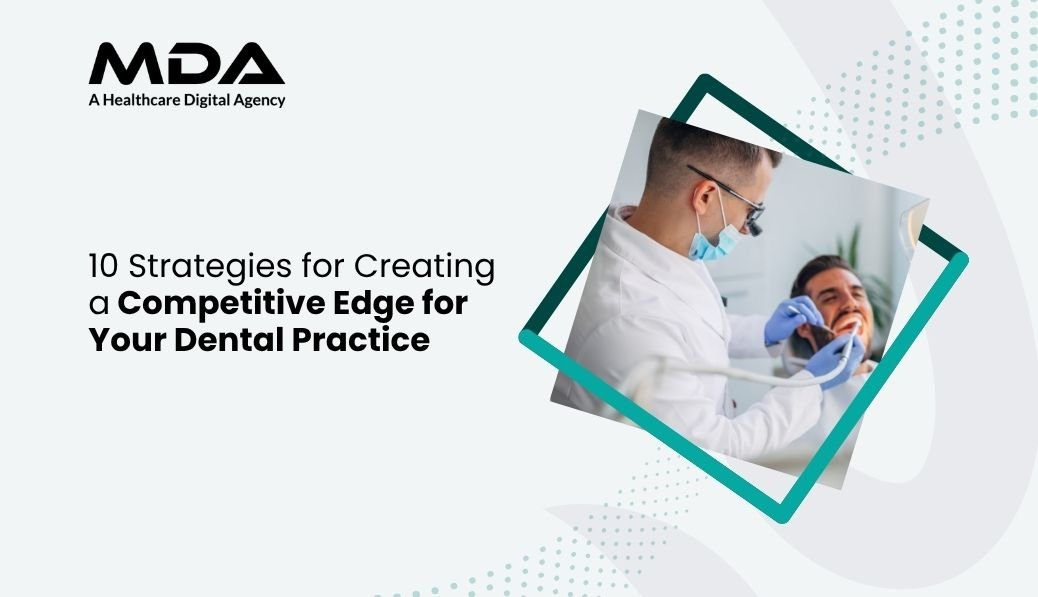
Every dental practice operates in a saturated market. New clinics open every quarter, dental service organizations expand aggressively, and patients have more choices than ever. Marketing alone does not create a sustainable advantage. Differentiation does.
A competitive edge is what makes a patient choose your practice over the one next door. It is built from positioning, patient experience, technology adoption, and strategic clarity. This blog covers ten strategies that move your practice from competing on price to competing on value, trust, and patient preference.
Trying to serve every patient with every service makes your practice forgettable. Practices that define a clear niche, whether pediatric dentistry, cosmetic implants, anxiety-free care, or full-mouth restoration, build stronger patient associations and stronger search visibility.
How to define your niche:
A niche-focused practice in a competitive market often outperforms a generalist clinic three times its size. Patients searching for specialized care prefer the practice that visibly specializes in their concern over one that lists every service generically.
In a market where clinical outcomes are similar, patient experience becomes the deciding factor. The clinic that feels welcoming, runs on time, and communicates clearly retains patients longer and earns more referrals.
Experience differentiators to build:
Most dental practices underestimate how much patient experience drives competitive advantage. A patient who waits 45 minutes for a five-minute consultation rarely returns. One who feels respected and informed becomes a long-term referral source.
Patients increasingly choose dental practices based on digital convenience. Online booking, mobile reminders, secure messaging, and easy access to records are now baseline expectations among younger demographics.
Tools that build a convenience advantage:
Partnering with the best healthcare app development company ensures these tools are compliant, well-designed, and clinically integrated. Practices that offer this digital layer feel modern. Those still requiring phone calls and paper forms feel dated.
Clinical technology, used well, becomes a visible competitive advantage. Intraoral scanners, digital impressions, 3D imaging, and laser dentistry all signal a forward-thinking practice to patients comparing options.
Technology investments that compound:
Promote these technologies on your website and social channels. Patients searching for “advanced dentistry” or “latest dental technology” actively look for practices that have invested in modern equipment.
A polished, consistent brand signals professionalism long before a patient meets your team. Inconsistent logos, outdated photos, and mismatched messaging across platforms signal the opposite.
Brand elements that build instant trust:
Practices that invest in professional branding charge higher fees with less resistance, attract higher-value patients, and reduce time spent comparing them to lower-end alternatives. Brand is not vanity. It is a measurable revenue lever.
Local SEO is not just visibility. It is competitive positioning. Practices that rank in the top three Google Map results capture significantly more inbound calls than those ranked four through ten.
Local SEO actions that build edge:
A focused healthcare SEO partner builds local visibility that compounds over time, creating organic patient flow competitors cannot easily replicate with paid advertising.
Patient education is rarely treated as a competitive lever, but it builds trust faster than any ad campaign. Patients who understand their treatment options accept more recommendations and refer more often.
Education formats that work:
Education positions your practice as the authority. Patients who learn from you trust you. Trust converts into bookings, retention, and referrals at rates pure promotional content cannot match.
Online reputation directly influences patient choice. Practices with 4.7-star ratings and 200 recent reviews consistently outperform competitors with fewer or older reviews.
Reputation systems that create edge:
A self-sustaining reputation engine compounds advantage. Each new review reinforces visibility, which generates more calls, which produces more reviews. Competitors who manage reviews reactively cannot match this momentum.
Most dental practices market by instinct. Practices that gain a sustained competitive edge market by data. They know which channels deliver patients, which treatments produce the highest lifetime value, and which messages convert at the highest rate.
What to measure:
Data does not replace clinical judgment. It informs every other decision. Practices that consistently outperform competitors share one trait: they know their numbers and act on them.
Generic marketing agencies miss the compliance, vocabulary, and patient psychology that dental practices need. A specialized agency offering digital marketing for dental clinics brings strategies designed around dental patient behavior, competitive dynamics, and regulatory requirements.
Specialization delivers:
This is the difference between marketing that occasionally produces results and marketing that consistently builds competitive advantage. Generic agencies experiment with your budget. Specialized agencies execute proven systems.
A competitive edge in dentistry is not built from a single tactic. It is built from layered advantages: clear positioning, exceptional patient experience, digital convenience, modern technology, strong branding, local visibility, education, reputation, data discipline, and specialized marketing partnership.
Most dental practices have one or two of these in place. The ones that lead their markets have all ten working together. Start with the strategy where your gap is largest. Compound the advantage over time. The edge belongs to those who execute consistently.
Differentiation comes from clear positioning, exceptional patient experience, modern technology, strong branding, and consistent local visibility. Practices that combine these elements with a healthcare-specialized marketing strategy outperform competitors who rely on price or generic promotion.
Small practices win by focusing on personalized care, specialty positioning, and community trust, areas where chains struggle. A boutique practice with a clear niche and strong patient experience often retains higher patient lifetime value than a chain location, even at higher fees.
Patient experience consistently produces the largest sustainable advantage. Clinical outcomes are similar across most practices, so patients judge their dentist on how they were treated, communicated with, and made to feel. A great patient experience compounds through referrals and reviews.
Yes, for multi-location practices and those serving younger demographics. A dedicated app offers appointment booking, records access, and teleconsultation in one place. This creates a digital convenience layer competitors without an app cannot easily match.
AI affects dental competition in two ways. First, AI diagnostic tools improve clinical outcomes. Second, AI search tools like Google AI Overviews and ChatGPT now surface dental answers directly. Practices optimized for both clinical AI and AI search gain a measurable advantage over those still relying only on traditional channels.

C – 81C, Sector – 8, Noida 201301, India


1025 Beamon Drive, Franklin 37064 Tennessee, USA
Sveavagen 34 111 34 Stockholm, Sweden

Copyright ©MDA. All rights reserved.

