
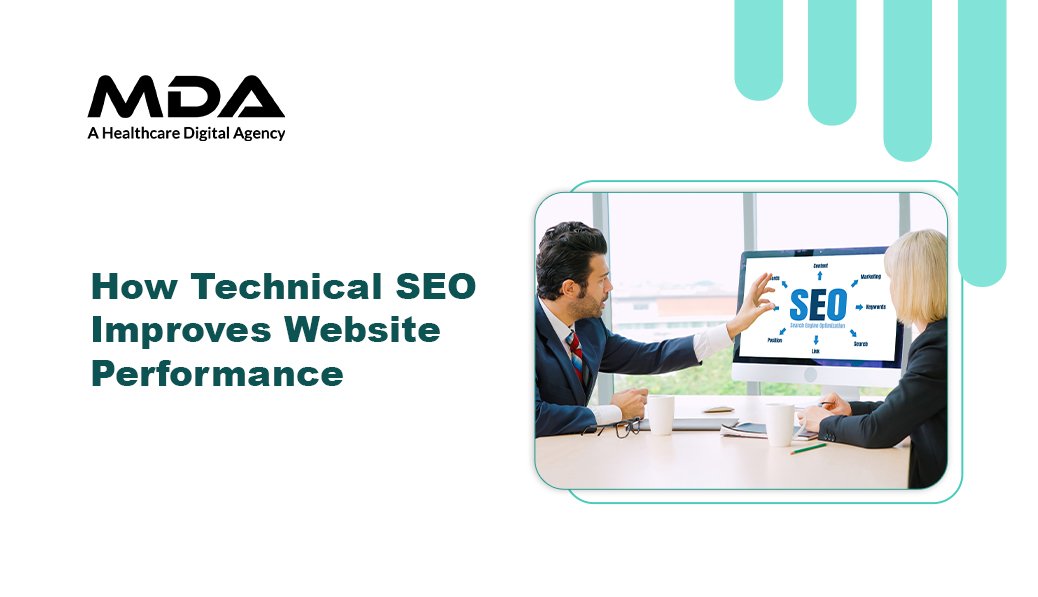
Your healthcare website exists on the intersection of clinical credibility and digital accessibility. When a patient is looking for treatment options or a hospital administrator evaluates your online presence, technical infrastructure is what determines whether or not your expertise gets to them. Technical SEO takes the invisible elements in the backend and turns them into measurable patient engagement and competitive visibility.
Technical optimization works on the structural basis that the search engines will check before the content quality matters. Page speed, mobile responsiveness, crawlability, and security protocols determine whether or not Google will index your pages, rank your services, and show your organization to searching patients. Without this base, your clinical expertise is undiscovered.
Healthcare organizations are different because they have specific technical requirements. HIPAA-compliant forms, appointment booking systems, patient portals, and medical content all require specific technical setups. When properly optimized, these elements help with both regulatory compliance and search visibility. The connection between backend performance and patient acquisition is direct and measurable.
Load time is a filter for the conversion. When your homepage takes four seconds to load, prospective patients close the browser tab. They then go searching again and discover your competitor’s faster site and schedule there instead.
Technical SEO deals with speed by compressing images, minimizing code, optimizing server response time, and using CDNs. Each second taken away from the load times decreases the bounce rates and helps you to have a better placement in search positions.
Healthcare websites have special speed issues. High-resolution medical imagery, appointment scheduling widgets, insurance verification tools, and HIPAA-compliant forms all add page weight. Technical optimization is a balance between functionality and performance so that the patient can have access to critical features without waiting.
Patients research symptoms, find providers near them, and make an appointment using mobile devices. Google’s mobile-first indexing means that your mobile site version is used to rank on all devices. If your mobile experience fails, then your desktop site is irrelevant.
Technical mobile optimization is larger than responsive design. Touch targets need sufficient space. Text should not require pinch-zooming to be read. Navigation menus must have thumb-friendly interaction patterns. Forms should not require a lot of typing, with autofill and dropdown choices.
Healthcare SEO services understand that mobile searches have high intent. Someone searching “urgent care near me” or “dermatologist accepting new patients” expects to get immediate answers with clear next steps. Technical infrastructure must provide for this urgency by providing quick load times, visible contact information, and easy appointment booking.
Search engines send out crawlers – automated programs that find, read, and index web pages. Technical barriers make it impossible for crawlers to access your content, and entire parts of your site become invisible in search results.
Site architecture establishes the efficiency of crawlers. Logical hierarchy and internal linking ensure that crawlers reach all important pages. XML sitemaps give a map of the priority content. Robots.txt files are used to direct crawlers away from administrative pages, but allow access to patient-facing content.
Healthcare websites can be complex in their structures: service line website pages, provider page directories, location-specific content, patient resources, and medical condition libraries. Technical SEO makes this complexity into a crawler-friendly architecture. Keep important pages within 3 clicks of the home page. Use breadcrumb navigation. Implement the hierarchy by having proper URL structures.
Duplicate content poses special problems for multi-location healthcare organizations. When there are three different locations offering the same services in a clinic, implementation in the form of canonical tags is needed to indicate which version should rank. This is used to prevent your own pages from competing against each other in the search results.
Schema markup is the translation of your web content into the language of search engines. This structured data makes way for improved search displays: star ratings for patient reviews, showing availability of appointments, listing accepted insurance, and provider credentials.
Healthcare organizations that implement schema markup enjoy higher click-through rates because the enriched listings stand out from a crowded search result. When your dermatology practice has listing features that make it easy for patients to see that you accept appointments, take certain insurance plans, and have patient ratings available in search results, you stand out from text-only competitor listings.
Security protocols have a direct effect on search rankings. Google has explicitly stated that it will favor websites that have their protocols secured (HTTPS) over their alternatives (HTTP). Browsers show “Not Secure” warnings to non-HTTPS sites, and immediately destroy patient confidence.
Healthcare websites gather sensitive information: contact information, insurance information, health concerns, and preferences for appointments. SSL/TLS certificates provide encryption of this data transmission to safeguard the privacy of patients when information is submitted through forms or when they log in to portals.
HIPAA compliance requires the appropriate technical safeguards for protected health information. While this alone doesn’t make a website HIPAA compliant, it does provide the basis for the necessary encryption required for any compliant healthcare website. Technical SEO implementation ensures the proper installation of the certificate, mixed content resolution, and the redirect configuration from the website from http to https.
Patient trust starts even before making an appointment. When prospective patients research your services, browser security indicators do make a difference in the perception of your organization’s credibility. Technical security becomes a visible trust signal that helps to secure the clinical reputation.
Unlike paid advertising, which ends when the advertising budget is up, technical optimization is cumulative value-building. Each improvement is compounded: faster load times are associated with lower bounce rates, which in turn, make engagement metrics that make up rankings better. Better rankings lead to more traffic, which leads to even more patient reviews that boost search visibility even more.
Healthcare SEO services with a focus on technical foundation allow content and marketing strategies to work at their best. By having your blog posts on treatment options load fast, display well on mobile devices, and turn up in search results with enhanced features, you can turn research into appointments.
Digital marketing for dermatologists and other specialists must include the technical infrastructure to support specialty-specific needs. Video content for procedures requires the proper compression and hosting. Before-and-after galleries demand optimization of images so that they remain diagnostic and are reduced in file size. Appointment booking systems must have an integrated nature without compromising page speed.
How is technical SEO different from regular SEO for Healthcare Websites?
Technical SEO is the optimization of website infrastructure (speed, mobile functionality, crawlability, and security), whereas content SEO is the optimization of the information you publish. Healthcare sites need both, but optimizing technical should create the foundation to get content to rank. HIPAA-compliant forms, patient portals, and appointment systems all need to be technically implemented in a way that balances functionality and search visibility.
What are the most common technical problems that adversely affect the performance of healthcare websites?
Slow page load times from oversized medical images, poor mobile optimization for touch-friendly navigation, lack of security with missing https security equating to poor patient trust, duplicate content across multi-location sites, and improper schema marking equating to lack of enhanced search results. A lot of healthcare websites are also plagued by crawlability problems, where their provider directory pages and service pages are not even crawled by the search engines.
Can technical SEO benefit my practice in local searches?
Local rankings are highly technical. Fast mobile load time, structured location pages with the appropriate schema markup for your address and service area, and NAP citations that are consistent across the various directories have an impact on your visibility in the local search. Technical optimization makes sure that Google’s local algorithm can accurately identify, categorize, and rank your practice for geographical searches.
How long does it take to see the results of technical SEO improvements?
Initial improvements are seen in a few weeks – faster page speeds have the immediate effect of reducing bounce rates and improving user experience metrics. Search ranking improvements usually take between one and three months as Google recrawls your optimized pages and promotes them according to better signals for improved performance. Sustained growth is sustained with the technical foundation that will allow content and authority-building efforts to work optimally.
Do I need a Technical SEO if my website is new?
New websites benefit most from proper technical implementation since correct infrastructure is built from the start, so there is no remediation work to be done later. Proper site architecture, mobile optimization, security protocols, and structured data implementation built into your initial design help you gain a competitive advantage and support long-term growth, immediately, with no costly rebuilds.
How does technical SEO impact patient appointment conversions?
Technical optimization has a direct effect on conversion rates through the reduction of friction. Fast load times help to prevent impatient users from dropping forms. Mobile-friendly interfaces offer a convenient way to book from any device. Secure HTTPS protocols help create confidence to submit personal information. Clear site architecture to help patients to find relevant services quickly. Each technical advance that is made eliminates a barrier to the process of research and appointment scheduling.
Should multi-location healthcare organizations think differently about technical SEO?
Multi-location organizations are faced with particular technical anomalies: replicating content on different location pages, complex site architecture handling many combinations of services, and local search optimization for each geographical area. Technical implementation through proper canonical tags, schema markup for locations, and internal linking is getting very important for not letting your own pages compete against each other and maximizing visibility across all markets.

C – 81C, Sector – 8, Noida 201301, India


1025 Beamon Drive, Franklin 37064 Tennessee, USA
Sveavagen 34 111 34 Stockholm, Sweden

Copyright ©MDA. All rights reserved.

